


By: Frances Shefter, Esq.
Right now, many schools are holding IEP meetings to decide if students qualify for Extended School Year (ESY) services. If you’re a parent, you may be wondering what ESY really is—and whether it’s the right choice for your child.
Let’s break it down in a clear, practical way so you can walk into your next IEP meeting prepared.
What Is ESY?
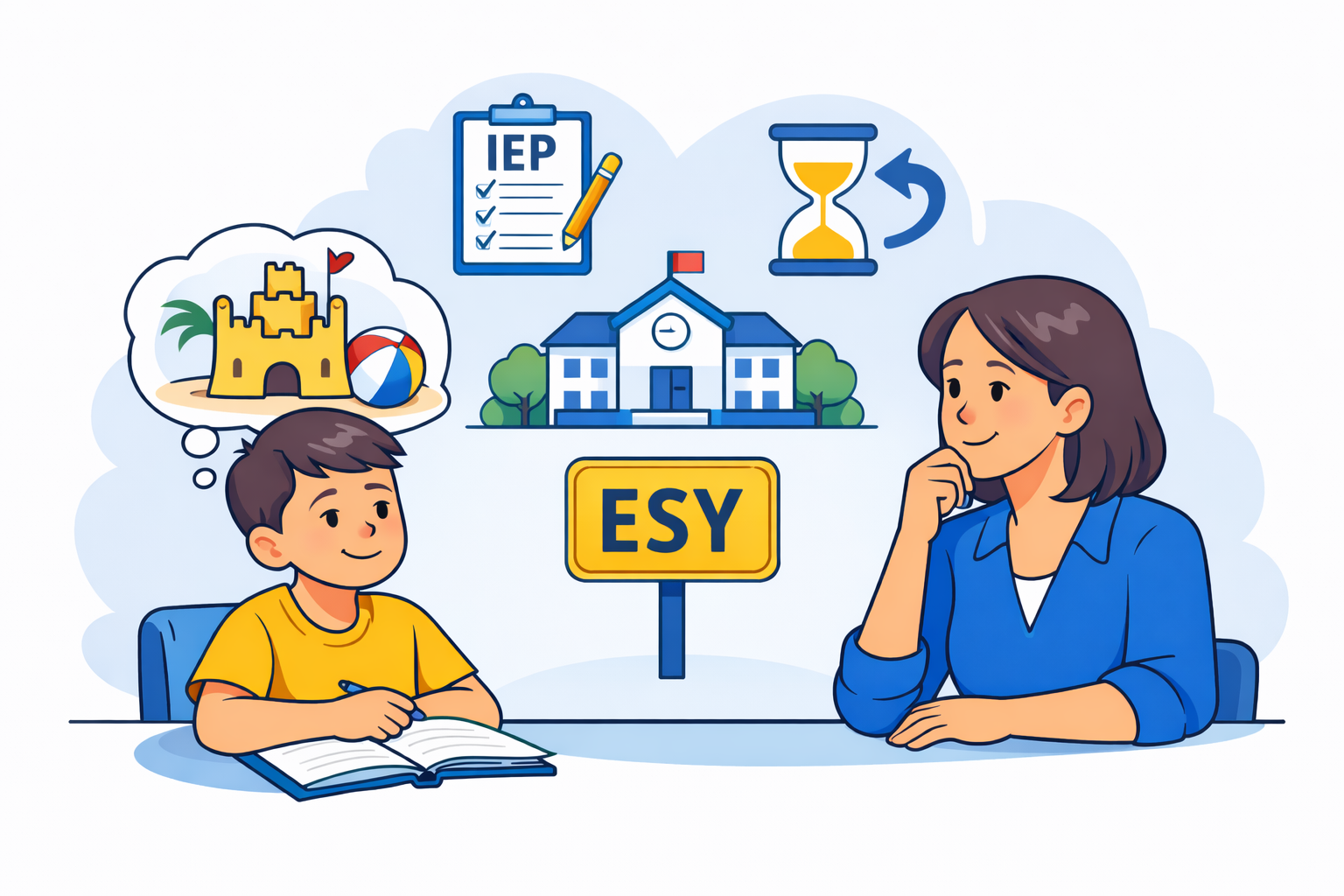
ESY services are special education services provided outside the regular school year, usually during the summer. The goal of ESY is to help students maintain the progress they’ve made on their IEP goals, or to prevent regression.
Many schools describe ESY as a summer program they offer. But technically, ESY is not supposed to be a one-size-fits-all program. Like an IEP, ESY should be individualized based on your child’s specific needs. That said, in practice, most schools offer a standard ESY schedule.
Typically, ESY looks like this:
- 3–4 weeks during the summer
- 4–5 days per week
- 4–5 hours per day
Where schools do individualize ESY, is by selecting which IEP goals will be worked on with your child. Also, whether related services (speech, OT, or PT) are needed.
Do You Have to Send Your Child to ESY?
I get this question a lot. The simple answer is no. Even if your child qualifies for ESY, you are not required to send them. This is your choice as a parent.
That’s why it’s so important to think through whether ESY makes sense for your child before your IEP meeting.
How to Decide If ESY Is Right for Your Child
Schools usually focus on data and eligibility rules when deciding ESY. But as a parent, you should also think about how ESY fits into your child’s life.
Here are three key questions to ask yourself:
- Will your child feel “punished” by going to school over the summer?
Some children are okay with it. Others really need that break. Your child’s emotional response matters. - Does your child lose skills over breaks and take a long time to regain them?
This is one of the biggest factors. If your child regresses during school breaks and struggles to catch up, ESY may be very important. - Do you already have summer plans, like travel or camp?
ESY schedules can be rigid. If it conflicts with plans that are important for your child’s growth (like social camps), that matters too.
A Simple Way to Think About It
If you answered:
- No to question #1
- Yes to question #2
- No to question #3
Then ESY is probably worth considering.
If your answers are the opposite, ESY may not be the best fit—and that’s okay.
If You Want to Advocate for ESY
If you believe your child needs ESY, be prepared to support your position with data. Schools rely heavily on documentation. Helpful evidence includes:
- Data showing regression after school breaks
- Notes on how long it takes your child to regain lost skills
- Proof your child is close to mastering an IEP goal and could lose progress without continued support
You should also ask the school for a copy of the ESY eligibility form they use. This helps you understand exactly what they are looking at—and how to prepare.
When ESY May Not Be the Best Option
For some students, ESY is not the most helpful choice.
- Students working toward a standard diploma, especially in middle or high school, often benefit more from summer school or targeted academic programs.
- Many children benefit greatly from summer camps, where they can build social skills and independence in a more relaxed setting.
Final Thoughts for Parents
ESY is not just a summer program—it is a service designed to support your child’s IEP goals. That is why your voice as a parent matters. You know your child best, so it is important to consider their individual needs, progress, and overall well-being when making this decision.
If you’re unsure whether your child should qualify for ESY, or you want help building a strong case, you don’t have to figure it out alone. Start by scheduling a free case analysis. From there, you can book a Strategy Session with an attorney to map out the best plan for your child.